1. Introduction: Jobsite Formwork Crisis & The Structural Limits of Timber
In reinforced concrete building construction, shuttering operations represent 20% to 25% of total structural superstructure expenditure. For decades, film-faced plywood made from birch, poplar, or combi cores has been the standard. However, timber is inherently hydrophilic (water-absorbing).
When alkaline fresh concrete slurry contacts timber, water penetrates screw holes and cut edges. The veneer layers expand, delaminate, and rot. Even premium birch plywood is exhausted after 5 to 8 pours, generating heaps of toxic waste and requiring endless budget replenishment.
This costly cycle has triggered an industry-wide transition toward high-strength engineering thermoplastics. Below are the 10 structural and financial reasons why forward-thinking construction sites are abandoning timber for SerPlywood polymer boards.
2. Reason 1: 0.00% Water Absorption — Total Moisture Immunity & Zero Swelling
Water is timber's greatest enemy. Film-faced plywood left in rain or immersed in concrete slurry absorbs 15-25% moisture, swelling from 18 mm to 20-21 mm and causing unsightly step joint offsets on finished ceilings.
SerPlywood polypropylene (PP) panels feature a certified 0.00% water absorption rate. Their non-porous molecular structure makes water penetration physically impossible.
- Zero Swelling: An 18.0 mm board remains precisely 18.0 mm on pour 1 and pour 60.
- Slurry Leak Prevention: Dimensionally stable panels keep joints tight, preventing slurry bleeding and honeycomb defects.
- Outdoor Stacking: Panels endure torrential rain, snow, or waterlogged slabs without warping or rotting.
3. Reason 2: 50–70+ Pour Lifespan — 8 to 10 Times the Durability of Timber
On traditional multi-story high-rises, purchasing a new batch of plywood every 6 to 7 floors was considered inevitable. A 30-story tower would consume 4 to 5 full formwork panel sets.
SerPlywood dismantles this paradigm. High-impact polypropylene copolymer cores, supported by proper 25-30 cm joist spacing, routinely achieve 50 to 70+ pours. A single set of SerPlywood completes the entire superstructure of a high-rise tower, and the boards are then transferred to the next development.
4. Reason 3: 70% Cost-per-Pour Reduction & The TCO Revolution
Procurement officers often focus solely on initial sheet purchase price. While timber plywood appears cheaper upfront, this represents an expensive procurement illusion.
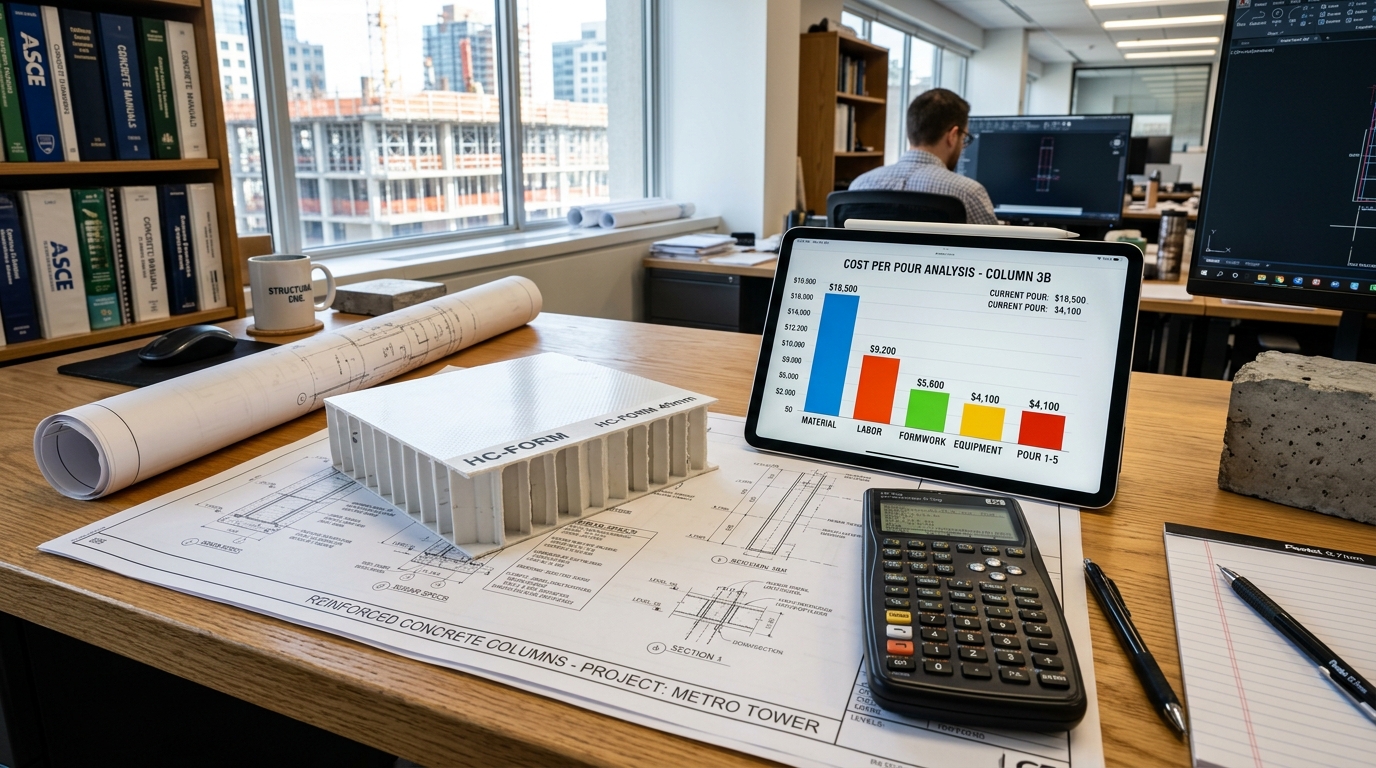
In civil cost engineering, the only metric that matters is Total Cost of Ownership (TCO) per Pour:
True Cost per Pour Formula:
Net m² Shuttering Cost = [Initial Sheet Purchase - Scrap Buyback Value] / Actual Pour Cycles Delivered
When timber plywood is discarded after 7 pours, its unit pour cost remains exorbitant. When SerPlywood's cost is distributed across 60 pours and credited with cash scrap buyback, total shuttering expenditure drops by up to 70%.
5. Reason 4: Mirror-Smooth SB3 Fair-Faced Concrete & Eliminating Plastering
Timber leaves wood grain imprints, resin bleeds, and surface wave defects after just a few pours. Correcting these surface flaws requires applying 20-30 mm of thick cement plaster across walls and ceilings.
SerPlywood's ultra-smooth polymer skin yields architectural SB3 fair-faced concrete:
- Upon striking, concrete surfaces are flat, pinhole-free, and uniformly grey.
- Base plastering, sand, and mortar mixing are eliminated entirely.
- Skim coat putty and primer paint can be applied directly onto the concrete.
- The plastering labor and material savings alone frequently offset the total purchase price of the boards.
6. Reason 5: 70% Less Formwork Release Agent & Stain-Free Surfaces
Porous timber requires heavy petroleum-based release agents (150-200 ml/m²) to prevent cement paste from bonding to the wood. Excess oil discolors concrete with dark yellowish patches and degrades paint adhesion.
Polypropylene boasts exceptionally low surface energy (natural non-stick properties). Fresh concrete does not adhere to the polymer. A light water-based misting of only 30-50 ml/m² is sufficient; on routine pours, panels release cleanly without any oil.
7. Reason 6: Fixed 24.5 kg Ergonomic Weight — No Water Logging on Site
Dry timber plywood weighs ~28 kg, but as it absorbs water and slurry on the jobsite, its weight swells to 38 to 42 kg. This requires two workers to carry a single sheet, increasing lumbar injuries and slowing down deck assembly.
SerPlywood 18 mm hollowcore panels remain at a constant 24.5 kg – 32.5 kg throughout their entire multi-month lifespan. Because they never absorb moisture, a single carpenter can comfortably carry and place panels on joist grids, increasing jobsite erection speed by 30%.
8. Reason 7: Accelerating Floor Cycles by 2 Days (Critical Path Advantage)
On commercial high-rises, time equals profit. Formwork stripping, surface cleaning, and re-erection dictate the Critical Path (CPM) of the structural schedule.
- No Scraping Required: Boards separate effortlessly from concrete with zero clinging residue. A quick pressure wash cleans panels in seconds.
- Reduced Crane Bottlenecks: Lightweight panels are hoisted manually or in swift crane bundles, cutting crane utilization by 30%.
- Early MEP & Finishing Start: Eliminating plaster curing delays allows mechanical, electrical, and drywall subcontractors to start weeks earlier.
9. Reason 8: All-Weather Resilience (-20°C Frost to +60°C Heat with Zero Brittleness)
Sub-zero winter weather makes conventional wood brittle and prone to split under nailing, while scorching summer sun warps boards.
SerPlywood's impact-modified polypropylene copolymer matrix retains viscoelastic flexibility even down to -20°C, absorbing vibrator hits and hammer blows without chipping. Under +60°C direct summer sunlight, built-in UV stabilizers maintain structural stiffness and shape integrity.
10. Reason 9: 100% Drop-In Compatibility with H20 Beams & Steel Frame Panels
Transitioning to polymer boards requires zero investment in new shoring or framing hardware:
- Standard Dimensions: Manufactured in 1250 × 2500 mm (and 1220 × 2440 mm) at 18 mm and 21 mm thicknesses, identical to timber plywood.
- System Compatibility: Fits seamlessly onto H20 timber beams, steel props, table forms, and modular wall clamps.
- Standard Woodworking Tools: Cut with regular carbide circular saws, nailed with standard duplex nails, or fastened with countersunk screws without special gear.
11. Reason 10: 100% Circular Economy, LEED Points & Cash Scrap Buyback
Spent timber plywood is coated in toxic phenol resins. Burning it releases hazardous emissions, dumping it is restricted, and disposal incurs costly landfill tipping fees. Timber scrap has negative financial value.
SerPlywood panels are 100% recyclable engineering thermoplastics. When boards reach the end of their long lifecycle, SerPlywood buys them back per kilogram at official scrap market rates. Reground in our crushing plants, the polymer is reborn into new industrial products. This closed-loop process earns vital LEED v4 and BREEAM waste diversion credits while returning cash directly to your bottom line.
12. 50-Pour Financial TCO Simulation on a 1,000 m² Formwork Area
A comprehensive financial comparison between birch plywood and SerPlywood polymer boards on a 1,000 m² slab deck across 50 concrete pour cycles (50,000 m² total contact area):
| Financial Parameter | Birch Timber Plywood (18 mm) | SerPlywood Plastic Plywood (18 mm) | Jobsite Financial Advantage |
|---|---|---|---|
| Average Panel Lifespan | 7 Pours (Discarded to landfill) | 50 – 70+ Pours | A single set completes the entire project |
| Total Panels Needed (50 Pours) | ~2,285 Sheets (7 Full Set Purchases) | ~320 Sheets (Only 1 Set) | 1,965 fewer sheets purchased and transported |
| Release Agent Usage (50,000 m²) | ~8,500 Liters (170 ml/m²) | ~2,000 Liters (40 ml/m²) | 76% reduction in chemical expenditure |
| Plastering Requirement | Mandatory (~50,000 m² ceilings/walls) | Zero Plastering (SB3 Finish) | Massive savings in sand, cement, and plasterer wages |
| Scrap Salvage Value | 0 USD (Incurs waste disposal costs) | Guaranteed Cash Scrap Buyback | Turns retired formwork into cash asset |
| NET FINANCIAL OUTCOME | High Recurring Waste & Expenditure | 70% Net Savings per m² Pour | Directly increases contractor project margin |
13. Where Is Plastic Plywood Indispensable? (Key Project Typologies)
High-Rise Residential & Commercial Towers
15 to 50 repeated floor cycles where buying new timber sets every 6 floors would decimate contractor profitability.
Heavy Infrastructure, Bridges & Tunnels
Demanding deep-pour hydraulic pressures (60-80 kN/m²), continuous moisture, and harsh jobsite handling conditions.
Architectural Fair-Faced Concrete Works
Museums, cultural centers, and exposed concrete facades where zero wave defects and uniform finish are mandatory.
Precast Concrete & Pipe Casting Yards
Daily demoulding operations requiring steam cure resistance and eliminating steel plate rust and scratch maintenance.
14. Conclusion & Jobsite Transition Checklist
Plastic plywood is not merely an alternative facing panel; it is a strategic productivity tool that accelerates jobsite progress, enhances worker safety, eliminates plastering rework, and reduces shuttering budgets by 70%.
4 Golden Rules for Maximizing Your Polymer Investment:
- Maintain joist spacing at 25-30 cm on slabs and 20-25 cm on walls.
- Place fasteners at least 15-20 mm inward from panel edges using duplex nails or countersunk screws.
- Use stripping wedges to release formwork rather than prying panels with crowbars.
- Return retired panels to SerPlywood upon project handover to collect your cash scrap refund.