
SERPLYWOOD · CORE GUIDE
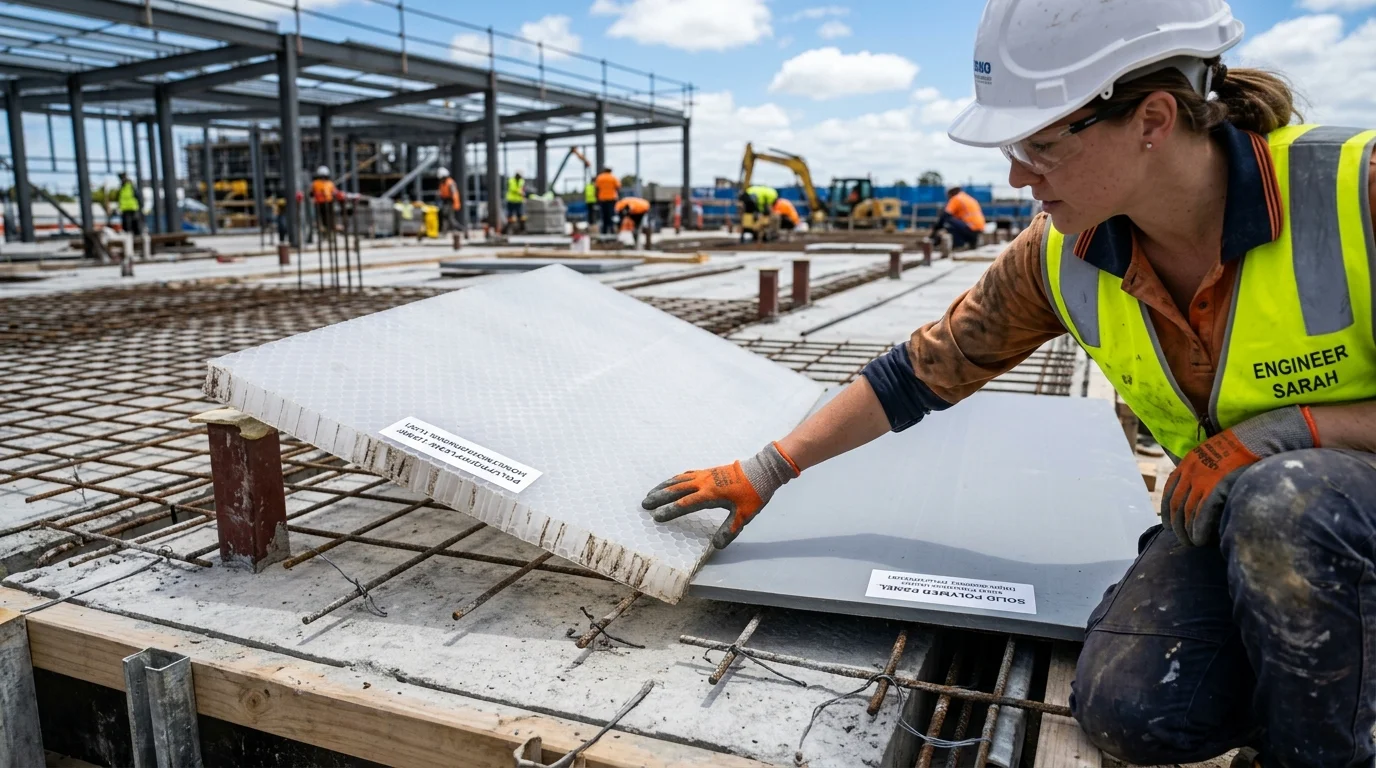
As polymer-based formwork boards replace film-faced timber plywood globally, civil contractors frequently compare Polypropylene (PP) and Polyvinyl Chloride (PVC) panels. While both guarantee zero moisture swelling and high pouring repetitions, their structural densities, cold-temperature ductility, and recycling economics differ radically.
Polypropylene (PP) Copolymer: Engineered with a cellular honeycomb hollow core bounded by dense solid polymer faces. This maximizes the cross-sectional moment of inertia while cutting panel dead weight by over 50%.
PVC Formwork: Typically manufactured as a dense solid or compact foamed matrix. While stiff, it possesses high specific gravity that increases physical fatigue on site.
For a standard 18 mm sheet measuring 1250×2500 mm (3.125 m²):
PVC has a glass transition temperature around +75°C to +80°C, meaning it operates in its glassy-brittle state at ambient conditions. Below +5°C, and particularly in sub-zero winter pours, PVC becomes brittle; heavy concrete vibrator strikes or corner drops risk cracking and fracture.
In contrast, block copolymer PP retains flexibility and impact absorption down to -20°C, making it the preferred choice for all-season construction.
PVC contains approximately 57% chlorine by weight. Exposure to hot rebar welding or site fire generates caustic Hydrogen Chloride (HCl) fumes. Polypropylene contains only carbon and hydrogen, burning cleanly without halogen acids. Furthermore, SerPlywood offers guaranteed buyback for used PP sheets, creating a zero-waste closed loop.
| Parameter | SerPlywood Cellular PP | Solid / Foamed PVC | Engineering Verdict |
|---|---|---|---|
| Weight (18mm, 1.25×2.5m) | 32 – 35 kg | 65 – 75 kg | PP 50% Lighter |
| Sub-Zero Impact (-15°C) | Ductile & Crack-Free | Embrittlement Risk | PP Superior |
| Edge Nailing Split Risk | Zero (Elastic grip) | Moderate near edges | PP Superior |
| Water Absorption | 0.00% | 0.00% | Tied (Both water-impervious) |
| Toxic Fume Emission | Halogen-Free | Corrosive HCl gas | PP Safer for Jobsite Crew |
| Scrap Buyback Value | High (Circular Economy) | Very Low | PP Financially Superior |
| Typical Pour Life | 60+ Pours | 35–50 Pours | PP Longer Lifecycle |
Receive an 18mm polymer sample panel and certified laboratory test certificates directly to your office.
Antworten zu Plattenauswahl, Einsatzzyklen, technischen Parametern und Lieferabwicklung.
Es ist ein handelsüblicher Begriff für Schalungsplatten aus Polymeren für Betonarbeiten. Bei der Beurteilung müssen Polymertyp (PP oder PVC), Querschnittsgeometrie, Abmessungen und Anwendungshinweise gemeinsam betrachtet werden.
Nein. Es gibt Platten aus PP, PVC sowie diversen Verbundstoffen. Im Angebot von SerPlywood werden Polymermatrix und Strukturaufbau stets transparent deklariert.
Nicht immer. Es gibt Hybridplatten mit Holzkern und Kunststoffbeschichtung. Kernmaterial und Oberfläche müssen separat betrachtet werden. SerPlywood bietet homogene Vollkunststoff-Platten.
Die Plattendicke allein entscheidet nicht über die Eignung. Plattenstruktur, Frischbetondruck, Trägerabstände und Befestigung müssen im statischen Schalungskonzept geprüft werden.
Je nach Baustellenführung, Schalungsbehandlung und Sorgfalt beim Ausschalen werden 40 bis über 80 Einsätze erreicht. Dies stellt einen praxisbewährten Erfahrungsbereich dar.
Im Inland liefern wir in der Regel ab einer Palette (ca. 40–50 Platten), im Exportgeschäft container- oder LKW-weise (20'/40' FCL). Sprechen Sie unseren Vertrieb für individuelle Bedarfe an.
Teilen Sie uns Abmessungen, Dicke, Menge und Lieferort mit. Wir erstellen ein Angebot mit klar definiertem Lieferumfang.