
SERPLYWOOD · CORE GUIDE
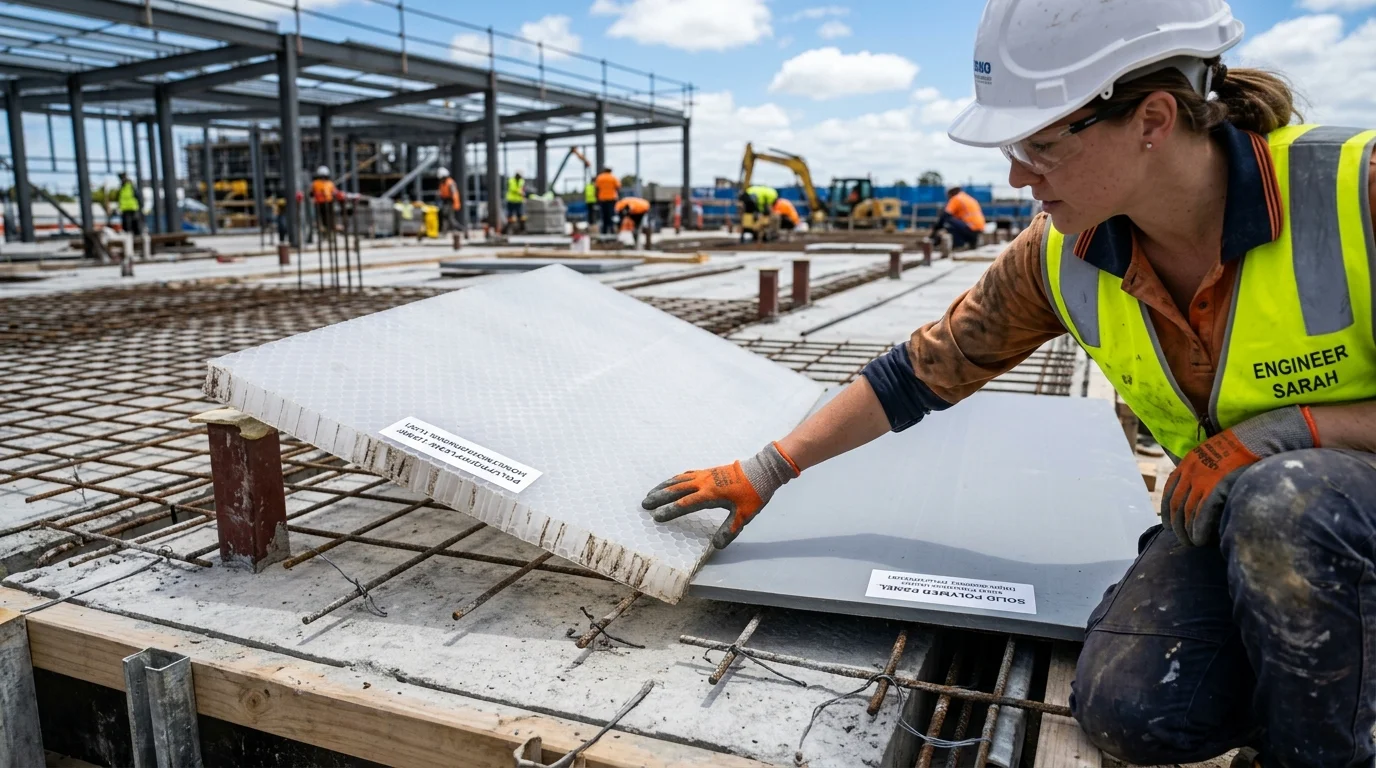
As polymer-based formwork boards replace film-faced timber plywood globally, civil contractors frequently compare Polypropylene (PP) and Polyvinyl Chloride (PVC) panels. While both guarantee zero moisture swelling and high pouring repetitions, their structural densities, cold-temperature ductility, and recycling economics differ radically.
Polypropylene (PP) Copolymer: Engineered with a cellular honeycomb hollow core bounded by dense solid polymer faces. This maximizes the cross-sectional moment of inertia while cutting panel dead weight by over 50%.
PVC Formwork: Typically manufactured as a dense solid or compact foamed matrix. While stiff, it possesses high specific gravity that increases physical fatigue on site.
For a standard 18 mm sheet measuring 1250×2500 mm (3.125 m²):
PVC has a glass transition temperature around +75°C to +80°C, meaning it operates in its glassy-brittle state at ambient conditions. Below +5°C, and particularly in sub-zero winter pours, PVC becomes brittle; heavy concrete vibrator strikes or corner drops risk cracking and fracture.
In contrast, block copolymer PP retains flexibility and impact absorption down to -20°C, making it the preferred choice for all-season construction.
PVC contains approximately 57% chlorine by weight. Exposure to hot rebar welding or site fire generates caustic Hydrogen Chloride (HCl) fumes. Polypropylene contains only carbon and hydrogen, burning cleanly without halogen acids. Furthermore, SerPlywood offers guaranteed buyback for used PP sheets, creating a zero-waste closed loop.
| Parameter | SerPlywood Cellular PP | Solid / Foamed PVC | Engineering Verdict |
|---|---|---|---|
| Weight (18mm, 1.25×2.5m) | 32 – 35 kg | 65 – 75 kg | PP 50% Lighter |
| Sub-Zero Impact (-15°C) | Ductile & Crack-Free | Embrittlement Risk | PP Superior |
| Edge Nailing Split Risk | Zero (Elastic grip) | Moderate near edges | PP Superior |
| Water Absorption | 0.00% | 0.00% | Tied (Both water-impervious) |
| Toxic Fume Emission | Halogen-Free | Corrosive HCl gas | PP Safer for Jobsite Crew |
| Scrap Buyback Value | High (Circular Economy) | Very Low | PP Financially Superior |
| Typical Pour Life | 60+ Pours | 35–50 Pours | PP Longer Lifecycle |
Receive an 18mm polymer sample panel and certified laboratory test certificates directly to your office.
Common questions regarding board selection, reuse cycles, technical parameters, and global delivery.
It is a widely used commercial term for polymer sheets used as concrete formwork facing. When evaluating the product, the polymer type (PP or PVC), internal cross-section, dimensions, and manufacturer instructions must be assessed together.
No. PP, PVC, and various polymer composites exist on the market. In SerPlywood quotations, the exact polymer matrix and internal structure are clearly stated.
Not always. Some hybrid products have a timber/plywood core with a plastic film or overlay. The core material and the surface must be evaluated separately. SerPlywood provides homogeneous solid/cellular polymer boards.
Thickness alone does not determine full suitability. Polymer structure, fresh concrete hydrostatic pressure, support joist spacing, and framing connections must be evaluated within a proper formwork design.
Depending on jobsite practices, handling care, and stripping discipline, boards achieve between 40 and 80+ concrete pours. This is a field-observed operational range under proper maintenance rather than an unconditional guarantee.
Domestic orders are typically handled on a full pallet basis (standard 40–50 sheets), while export deliveries require 20' or 40' container loads. Contact sales for specific site requirements.
Share your required board dimensions, thickness, estimated quantity and delivery destination for a clearly scoped quotation.