Technical Specifications & Standards
Mechanical properties, flexural modulus, thermal expansion parameters, and load-deflection support spacing tables for SerPlywood polymer boards.
What is Plastic Plywood? Fundamentals & Material Selection Guide
Discover polypropylene copolymer chemistry, PP vs PVC differences, and 60+ pour guidelines in our comprehensive guide.
1. Destek Aralığı ve Sehim Kontrolü
Polimer levhalar elastik davranış gösterir. Sıcaklık ve taze beton hidrostatik basıncı altında sehimin sınırları içinde kalması için ızgara kiriş aks aralıklarının doğru projelendirilmesi gerekir.
| Formwork Type | Board Thickness | Concrete Load | Max Recommended Joist Spacing | Permissible Deflection |
|---|---|---|---|---|
| Slab Formwork | 18 mm PP Honeycomb | 20 - 30 cm Slab Depth | 25 – 30 cm | ≤ L/500 (< 1.5 mm) |
| Heavy Slab / Waffle | 18 mm / 21 mm PP | 35 - 50 cm Slab Depth | 20 – 25 cm | ≤ L/500 (< 1.0 mm) |
| Wall & Column Formwork | 18 mm PP Honeycomb | 50 – 70 kN/m² Lateral Pressure | 25 – 30 cm | ≤ L/400 (< 2.0 mm) |
| Beam Soffits | 18 mm PP / PVC | Heavy Beam Rebar & Pour | 20 – 25 cm | ≤ L/500 (< 1.0 mm) |

Cutting & Sizing Rules
- Easily cut using standard circular saws, jigsaws or hand tools exactly like timber plywood.
- For clean, burr-free cuts, use fine-tooth carbide blades (60-80 teeth).
- On cut cellular edges, sealing tape or aluminum U-profiles may be applied to prevent cement paste entry.

Nailing & Fastening Standards
- Standard jobsite nails or wood screws can be driven directly without pre-drilling.
- To facilitate rapid stripping and prevent face damage, duplex double-headed formwork nails are recommended.
- Fasteners should be driven at least 15–20 mm inward from sheet edges.
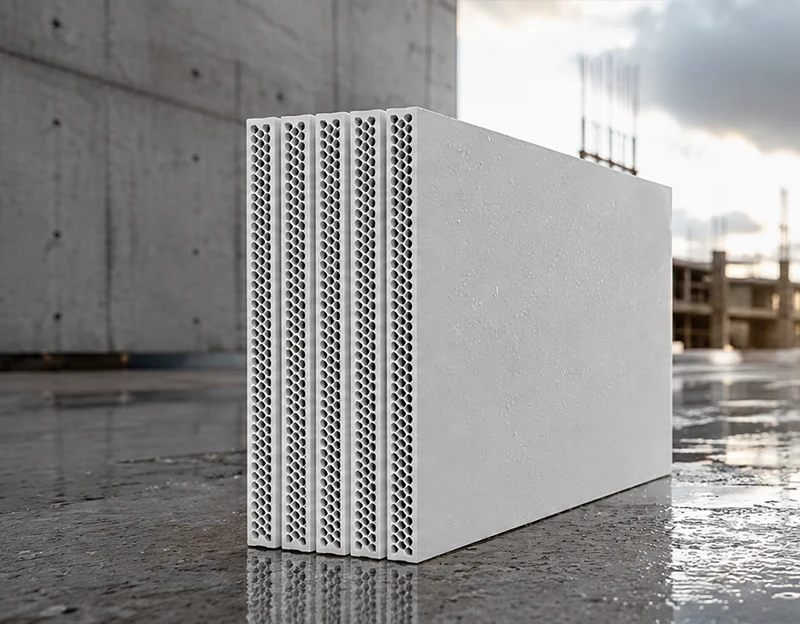
100% Waterproof Vertical Honeycomb Core
Engineered vertical cells deliver peak stiffness-to-weight ratio while maintaining dead weight at 32 kg (18 mm). Non-porous outer polymer skin guarantees zero water absorption (0.00%).
3. Termal Genleşme ve Derz Boşluğu Yönetimi
Polymer boards have a thermal expansion coefficient (~0.08 mm/m/°C). When setting slab formwork in hot ambient temperatures, leave a 1 – 2 mm expansion gap at sheet joints.
Technical Guides & Engineering Field Studies
Explore PP vs PVC analysis, 18mm tender specifications, cost-per-pour calculations, and thermal dilation guidelines.
Engineering & Specification FAQs
Frequently Asked Questions
Common questions regarding board selection, reuse cycles, technical parameters, and global delivery.
The polymer name alone is not a sufficient selection criterion. Internal cross-section (solid, honeycomb, or fluted), weight, test certificates, jobsite temperature ranges, and pricing must all be evaluated together.
They describe the internal cross-sectional geometry of the board. Honeycomb and cellular structures provide lightweight handling, while solid core boards offer different deflection and impact dynamics.
The operating model is specialized polymer formwork procurement, supply, and direct project delivery. Manufacturing and authorized distribution credentials are fully specified within institutional documentation.
Manufacturer declarations and technical compliance certificates must be examined. Recycled content ratios and polymer origins vary, and SerPlywood provides verified technical documentation for material compliance.
Thickness alone does not determine full suitability. Polymer structure, fresh concrete hydrostatic pressure, support joist spacing, and framing connections must be evaluated within a proper formwork design.
Yes, when the framing is engineered for the concrete pour rate and lateral hydrostatic pressure, they perform exceptionally in wall and column panels.